
Claude is strong on policy-heavy support
When teams care about careful phrasing, refusal quality, and lower risk of overly confident answers, Claude is often the cleanest starting point.
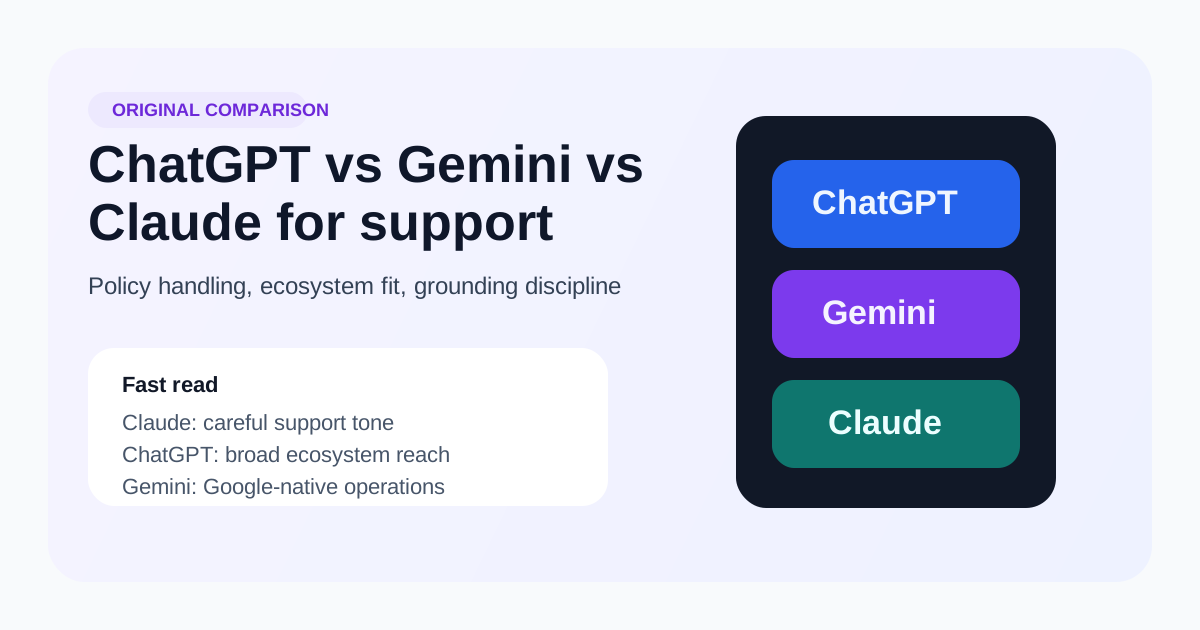
For customer support, the best model is the one that stays grounded, follows policy reliably, and works inside a support system with good escalation and analytics. Claude often wins on tone and policy adherence, ChatGPT on ecosystem breadth, and Gemini on Google-stack alignment.
This comparison is not about abstract benchmark scores. It is about what model choice means when you are deploying a support assistant that needs to be safe, useful, and measurable inside a queue.
These are the key points the page is trying to help the reader decide quickly.
When teams care about careful phrasing, refusal quality, and lower risk of overly confident answers, Claude is often the cleanest starting point.
If the support workflow touches many tools, builders, or partner ecosystems, ChatGPT-backed stacks often give the broadest integration path.
Gemini becomes more attractive when the team already works inside Google Workspace, Google Cloud, or Google-heavy enterprise stacks.
The correct question is not which model is universally best. It is which model reduces operational risk in your support environment.
| Model | Where it usually wins | Where to be careful | Best fit |
|---|---|---|---|
| ChatGPT | Broad ecosystem support, tool availability, and product familiarity | Can still drift without strong grounding and policy scaffolding | Teams that want broad vendor optionality and fast experimentation |
| Gemini | Google-centric workflows and enterprise alignment | Needs the same grounding and workflow discipline as any other model | Organizations already standardized on Google systems |
| Claude | Careful phrasing, safety-sensitive responses, and policy adherence | May be less attractive if the wider stack heavily favors another vendor | Support teams prioritizing tone, control, and escalation quality |
Support assistants fail because of missing knowledge controls, weak escalation logic, poor instrumentation, or bad retrieval quality long before they fail because of a model logo. That is why model comparison should come after workflow design, not before it.
Still, model behavior does show up in customer support. Tone, policy consistency, grounding discipline, and the way a model handles uncertainty all affect whether an assistant is trusted by agents and customers.
Keep the first evaluation narrow. Run the same support intent set through each candidate stack, compare grounded accuracy, refusal quality, and handoff behavior, then judge the model inside the product environment where it will actually run.
The cleanest support decision is usually a model plus product choice, not a model-only choice. A good support application can make an average model deployment usable, while a weak support system can waste even a strong model.
These tool pages are the practical next step once the reader understands the workflow and wants to compare products.
Fresh stories that reinforce why this topic keeps changing and where vendor or platform decisions are moving.
Claude is often the better fit when careful language and policy adherence matter most, but a support product with better grounding and escalation can outweigh model-level differences.
No. If your grounding, retrieval, escalation, or agent handoff is weak, a model switch will not solve the operational problem.