
Pick for workflow fit
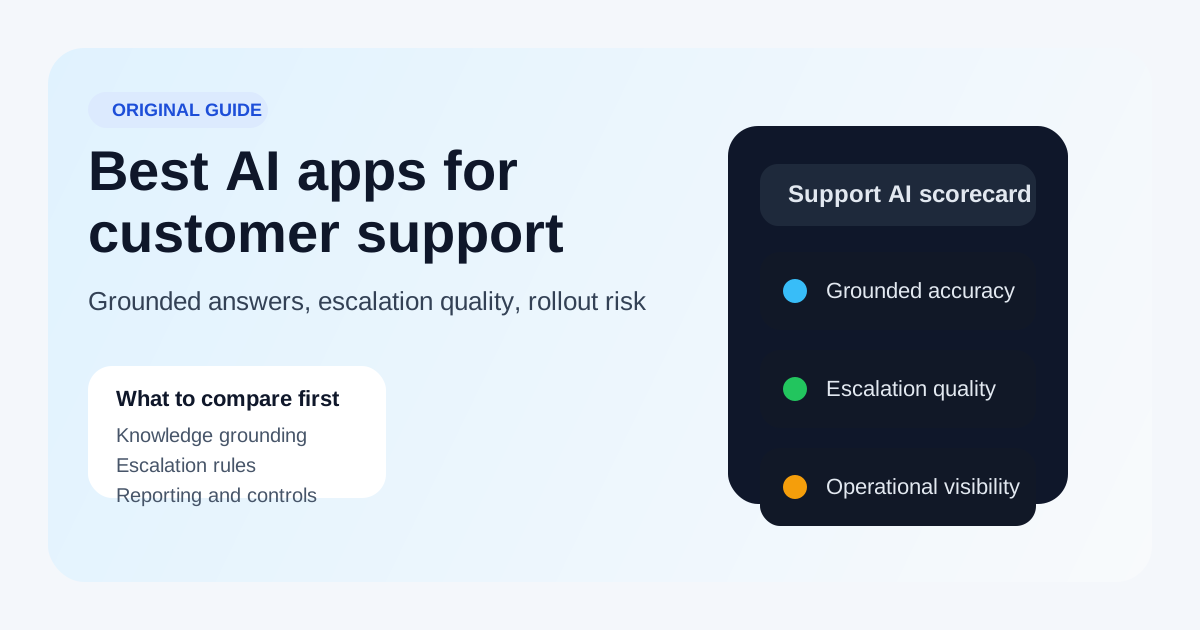
Choose a support AI app based on knowledge grounding, escalation control, analytics, and deployment constraints, not on the raw model brand alone.
The best AI apps for customer support are the ones that can ground answers in your help center, enforce escalation rules, and reduce handle time without creating hallucination risk.
Most teams do not need a generic chatbot shortlist. They need to know which product class fits support operations, what to compare first, and where a pilot will fail before it reaches production. This page is built around that decision, not around vendor marketing copy.
These are the key points the page is trying to help the reader decide quickly.
Choose a support AI app based on knowledge grounding, escalation control, analytics, and deployment constraints, not on the raw model brand alone.
The cleanest rollout is a narrow pilot on repetitive support intents such as order status, shipping, refunds, or knowledge-base lookup.
If the tool cannot route edge cases, attach ticket context, and expose confidence or fallback logic, it will create more support debt than it removes.
This is the comparison that matters before you get pulled into vendor demos. The fastest win usually comes from matching the product category to the support motion you already have.
| Option | Best for | Why it wins | Tradeoff |
|---|---|---|---|
| Chatbase | Teams with a strong help center and high self-serve volume | Fastest path to grounded answers and visible source references | Needs disciplined documentation quality to perform well |
| Chaindesk | Operators who want support automation with more orchestration flexibility | Good fit when you need multiple data sources and more workflow control | Setup can get heavier than simpler chatbot tools |
| Build Chatbot | Smaller teams that care about launch speed over deep support ops | Simple path for website assistant deployment and basic customer-facing coverage | Usually lighter on enterprise controls and reporting depth |
| Browse AI | Operations teams where support depends on external systems and monitoring | Useful when the support workflow includes automation beyond chat itself | Not a direct replacement for a support-first assistant layer |
The first filter is whether the app can answer from your approved knowledge base instead of improvising from a raw model. That sounds obvious, but it is still the line between a useful assistant and a liability.
The second filter is operational control. Look for escalation paths, transcript visibility, routing rules, source citations, and analytics around unresolved conversations. If those controls are missing, the app may look impressive in demos and still fail inside a real queue.
Run the pilot on one recurring intent cluster and measure containment rate, handoff quality, and time saved for agents. Avoid testing across every support category at once. Broad pilots hide where the tool is actually strong.
The first questions to answer are operational: did resolution speed improve, did bad answers decrease after grounding, and did the team gain trust in the fallback behavior. Those answers matter more than abstract claims about the underlying model.
These tool pages are the practical next step once the reader understands the workflow and wants to compare products.
A commerce-first option for Shopify merchants who want product answers, recommendations, and conversion support in one chatbot layer.
A strong first benchmark for grounded support and knowledge-base workflows.
A practical comparison when the team needs more orchestration and support automation depth.
Useful as a speed-first option for teams prioritizing quick assistant deployment.
Fresh stories that reinforce why this topic keeps changing and where vendor or platform decisions are moving.
A reminder that user-facing AI value depends on fit and restraint, not feature sprawl.
Relevant if you think support AI will need broader context access instead of static documentation alone.
Use these GPT pages when a narrower task-specific workflow is enough and a full app would be overkill.
For most teams, the best starting point is the app that can reliably ground answers in existing documentation and hand off to humans cleanly. That usually matters more than the brand of the underlying model.
Only after you confirm the product can manage knowledge, routing, escalation, and reporting. Model access matters, but the support system around the model matters more.