
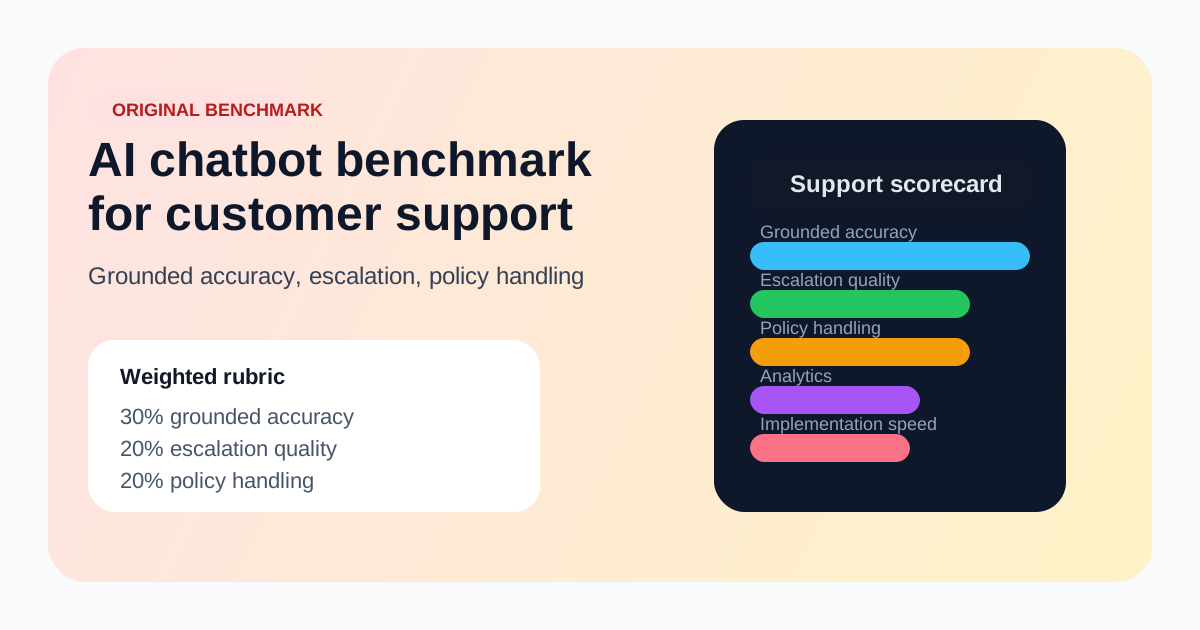
Grounded accuracy is the first score
If the assistant cannot answer from approved knowledge reliably, every other benchmark category becomes secondary.
A useful AI chatbot benchmark for customer support should score grounded accuracy, escalation quality, policy handling, analytics, and implementation control. Those criteria matter more than a vendor’s demo conversation.
Most chatbot comparisons are soft on evaluation. They rely on marketing claims, isolated conversations, or generic feature lists. A support benchmark should instead be built around the operational conditions where the assistant succeeds or fails.
These are the key points the page is trying to help the reader decide quickly.
If the assistant cannot answer from approved knowledge reliably, every other benchmark category becomes secondary.
A chatbot that hands off poorly will create downstream support debt even if it appears to resolve many conversations.
Benchmark on shipping, refunds, account access, product questions, and exception handling instead of synthetic prompts only.
Use this rubric to score tools during a pilot. The goal is not to pick a winner in the abstract. It is to identify which product reduces operational risk in your actual queue.
| Criterion | What to look for | Why it matters | Suggested weighting |
|---|---|---|---|
| Grounded accuracy | Correct use of approved docs and visible source references | This is the foundation for trust and containment | 30% |
| Escalation quality | Clean handoff, transcript context, and fallback logic | Bad handoff erases the value of partial automation | 20% |
| Policy handling | Consistent treatment of refunds, compliance, or sensitive cases | Support risk usually appears here first | 20% |
| Analytics and controls | Conversation visibility, routing rules, and operator settings | Without controls, teams cannot improve or govern the assistant | 15% |
| Implementation speed | How fast the team can pilot and maintain the tool | A slower rollout increases cost and internal resistance | 15% |
A demo can make almost any assistant look competent. What it does not show is how the product behaves on messy support requests, partial knowledge, policy edge cases, or low-confidence handoffs.
That is why a ranking page alone is not enough. If the page does not explain the evaluation framework, it is not giving an operator enough information to buy responsibly.
The result should be a short report that explains which tool handled grounded answers well, which one failed gracefully, and which one gave operators the controls they need. The best support AI choice is usually the one with the lowest operational surprise, not the flashiest response style.
That benchmark output also creates a reusable buying framework. Future evaluations get easier when the team agrees on the rubric before the next vendor pitch starts.
These tool pages are the practical next step once the reader understands the workflow and wants to compare products.
A stronger fit when the Shopify use case is really about sales assistance, product discovery, and conversion support.
A practical candidate when benchmark criteria include workflow control and support automation depth.
A strong benchmark candidate for grounded knowledge-base responses.
A useful speed-first baseline in a support chatbot comparison.
Fresh stories that reinforce why this topic keeps changing and where vendor or platform decisions are moving.
Useful context for how broader memory and context products could affect support evaluations.
Infrastructure shifts can affect pricing, vendor leverage, and the support tool market over time.
Grounded accuracy is the first metric because it determines whether the assistant can be trusted to answer from approved knowledge at all.
No. Containment without good escalation or policy handling can create hidden operational damage. It has to be read alongside transcript quality and handoff behavior.